Dr. Robert Venza taught history at good ole Murray State. He drove us to the brink as he tested from the text book but lectured about the little known events and people of the period of study.
Fast forward to today and the folks at Farm Equipment published a challenge, that if you were on a bus with a lot of icons of the ag industry, like Harry Ferguson for example, who would you sit with and what would you ask them. True to form, I decided to write about a man who probably would not even have been allowed on this bus.
This little known, for many reasons, man was William Ellison Jr. He was born and named April Ellison, a slave, named as many were for the month he was born and his master. Ellison was soon noted as a genius. Mainly self-educated, he was given the opportunity to earn extra money for his ability to invent and fix things. He eventually bought his freedom and then his wife's.
He set up a business and, among other items, worked on a device to remove seed from a cotton bowl and extract the fibers. A cotton Gin. Now wait, you say, I know for a fact Eli Whitney invented the cotton gin because I got that correct on a test many times. Nope, he patented one. He had the connections and the money. There was a huge problem — Eli's gin didn't work! It used metal bristles that tore the fibers, it was slow and it choked up.
A rival inventor, Hogden Holmes, along with Ellison, used saw blades in lieu of bristles and these worked. Eli sued Holmes for patent infringement and won. Then he switched his bristles out for Holme's sawblades. All the time Ellison was perfecting his own gin — the Ellison Gin. His gins sold — big time. Due to his engineering powers, he saw the faults of other gins and did things like use better quality blades that his foundry in Stateville, S.C.m made, and perfected the tooth angle. The stripper plates between the blades were correctly angled and precisely shaped to allow the blades to pull the lint through but not the seed. Then he added a feature few machines anywhere had — a precision balance job.
His gin could run faster, clean more cotton, save better seed and did not break down due to vibration as others did when running at maximum speed. The fiber was almost perfect and when graded, brought $2-$4 per bale more than any other gin. "Just a few bales pay for the premium price of an Ellison Gin" was the word-of-mouth advertising before the farm press existed.
Who built these machines in his factory? This is the tough part; Ellison purchased slaves. His two sons worked with him and they owned slaves as well. Can we see why he never made the history books? Why was he not sued by Whitney? He lived under “Black Codes” and therefore had no legal status. The Ellison Gin sold for double what the others did. His gins were sold and delivered by the Ellison Company and were not just “dropped off.” They were installed and custom set up to each farm. They had different gears for water or mill power vs. horse powered units. He gave a warranty of sorts.
If one was a farmer of status, one had an Ellison. The Ellison gin allowed the unbelievable expansion of cotton acreage. Just as in farms today, the scale of operation back then had to increase to survive. Today farmers have to have more or larger tractors to expand. The tractor was not invented then, so ... There is too much to write here, but if you ask Dr. Google about this history you are going to discover that in the south there were free people of color who owned for profit businesses, including plantations, that owned slaves. This is not in the history books, and save for Dr. Venza, this iron peddler would have never known.
Anyway, I would have liked to ask Mr. Ellison if he had any idea of the ramifications of his invention. What if they had never invented the gin? Without high-capacity gins, cotton would have never been “King” and the cash crop that caused its expansion from the south to the newly added states would not have had the political and shooting battles that resulted. The south might have been forced to develop industrially like the north. The north, without cotton would never have had the thriving textile industry whose products were sold here and around the world.
What if the cotton gin had been invented after the tractor? Lots of questions I wish I could ask, even about him being the only black family allowed in his local church. I would wrap up by saying William Ellison Jr., a farm equipment shortline manufacturer, perfected and sold a machine that changed the history of these United States, and possibly the world, more than any other single piece of farm equipment.
|
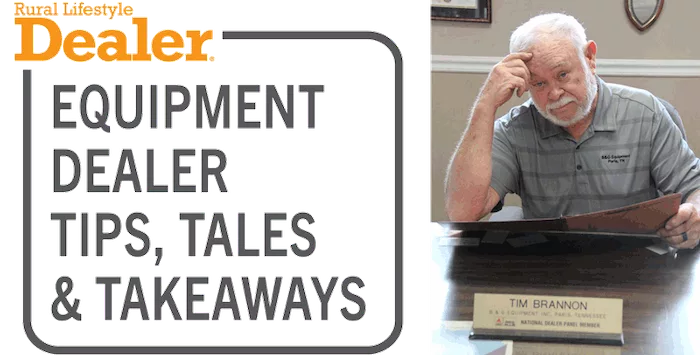
Told from the perspective of an in-the-trenches owner/operator — Tim Brannon of B&G Equipment, Paris, Tenn. — Equipment Dealer Tips, Tales & Takeaways shares knowledge, experiences and tips/lessons with fellow rural equipment dealerships throughout North America. Covering all aspects required of an equipment dealership general manager, Brannon will inform, entertain and provide a teachable moment for current — and future — leaders within equipment dealerships. |
 |